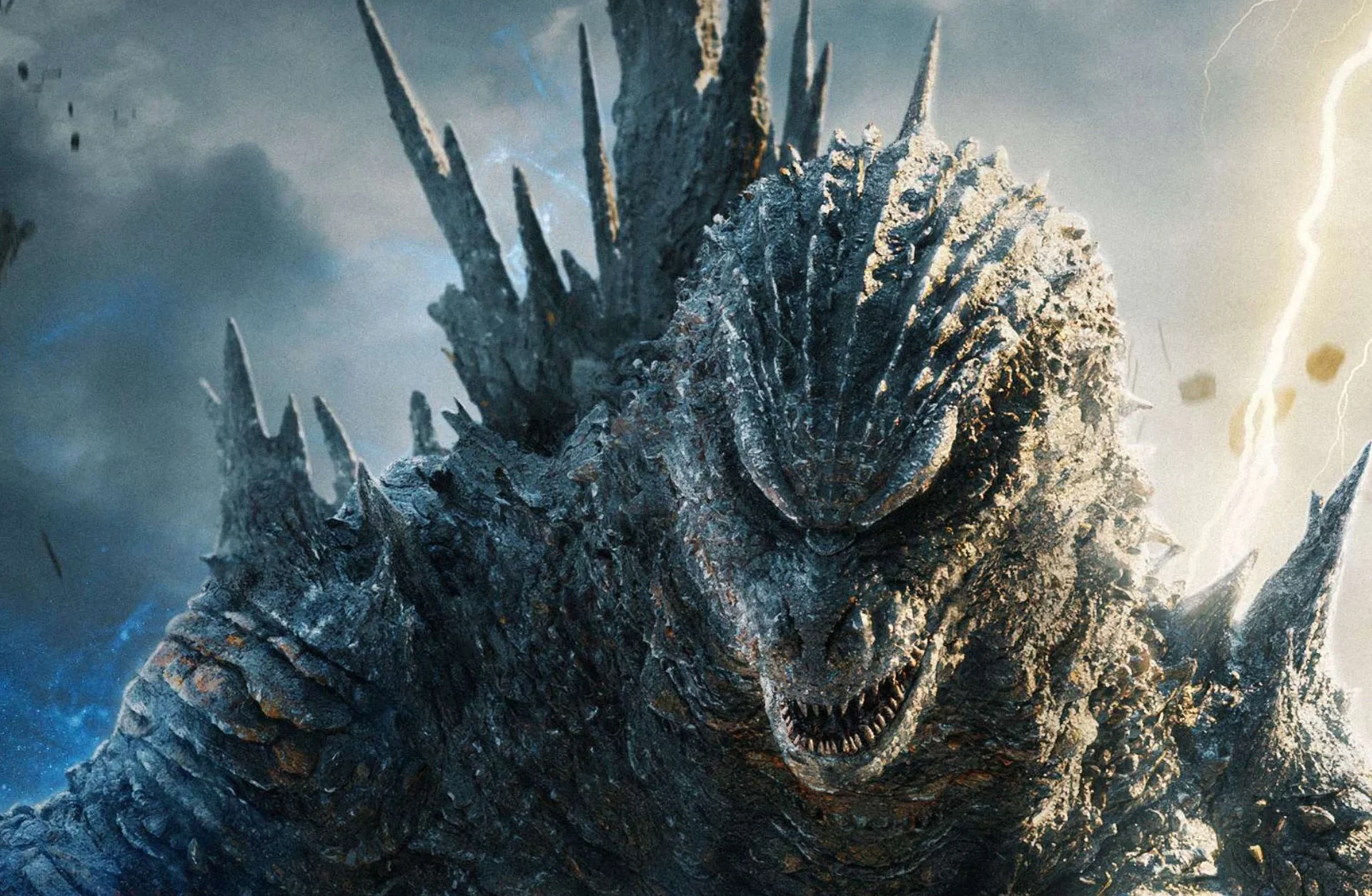

Takashi Yamazaki returns to the world of Godzilla with a spectacular, action-packed sequel that trades some of its predecessor’s emotional ambitions for old-fashioned monster-movie mayhem—and might actually be better for it.
When Godzilla Minus One arrived in theaters in 2023, it seemed to accomplish the impossible. Here was a relatively modest Japanese production about a giant radioactive lizard stomping through postwar Japan that managed to capture the attention of audiences and critics around the world. It became a genuine theatrical phenomenon, earned an Academy Award for Best Visual Effects, and helped remind moviegoers why seeing something enormous and terrifying on a gigantic screen surrounded by strangers can still be an extraordinary experience.
It was also, according to seemingly everyone who saw it, one of the greatest monster movies ever made.
I liked Godzilla Minus One quite a bit. I really did. But I never quite bought into the overwhelming hype surrounding it. The film was entertaining, visually impressive, and frequently spectacular, but I also found it rather predictable, with some storytelling decisions that undermined the emotional impact it was working so hard to achieve. Certain dramatic developments felt contrived, while others seemed designed specifically to manipulate the audience rather than emerge naturally from the characters and their circumstances.
That doesn’t make it a bad movie. Far from it. I thought it was an excellent creature feature, and that’s ultimately what it was: a monster movie. Not The Godfather. Not some revolutionary reinvention of cinematic storytelling. A really good movie about Godzilla destroying things, with an ambitious human drama wrapped around the destruction.
And there is absolutely nothing wrong with that.
Perhaps even more importantly, Minus One accomplished something that went well beyond its narrative. At a time when the theatrical experience seemed to be fighting for survival, this Japanese-language monster movie brought people back into theaters and reminded audiences that spectacle, imagination, and a little old-fashioned cinematic magic could still put people in seats. It also helped breathe new life into one of cinema’s most beloved and enduring characters.
So, naturally, a sequel was inevitable.
The question was whether Godzilla Minus Zero could capture that same magic. After all, sequels rarely manage to recreate the excitement of their predecessors, and the Godzilla franchise has certainly produced more than its fair share of questionable follow-ups over the decades.
Surprisingly, I think Minus Zero might actually be the more rewarding experience.
Returning as writer, director, and visual effects supervisor is Takashi Yamazaki, the filmmaker responsible for giving Godzilla one of his most successful modern reinventions.
Yamazaki is hardly a newcomer to Japanese cinema. His career stretches back decades, with films such as Always: Sunset on Third Street (2005), Space Battleship Yamato (2010), and The Eternal Zero (2013) demonstrating his fascination with historical settings, elaborate visual effects, and stories about ordinary people confronting extraordinary circumstances.
His experience in visual effects has always been central to his filmmaking, and that background proved particularly valuable with Godzilla Minus One. Working with a relatively small effects team, Yamazaki helped create a film that frequently looked more impressive than Hollywood blockbusters costing many times as much.
The results earned the production an Oscar for Best Visual Effects, a historic achievement for Japanese cinema and a remarkable validation of what can be accomplished when technical ingenuity and creative vision are allowed to take precedence over sheer spending.
With Minus Zero, Yamazaki returns to familiar territory, but this time with the expectations of the entire world hanging over him.
The story picks up in 1949, two years after the events of Minus One. Japan is still struggling to recover from the devastation of World War II and Godzilla’s previous rampage. The country is attempting to rebuild, its people are trying to establish some semblance of normalcy, and the survivors of the original film are hoping that the worst is finally behind them.
Of course, anyone familiar with Godzilla knows that normalcy is generally a temporary condition.
What follows is a larger, more action-oriented adventure that places considerably greater emphasis on the monsters themselves, the escalating threat, and the kind of kaiju-on-kaiju conflict that helped define some of the franchise’s most entertaining installments.
And for me, that shift in emphasis works beautifully.
One of the things I appreciated most about Godzilla Minus Zero is that it doesn’t seem quite as determined to convince the audience that it is something more profound than a Godzilla movie.
That’s not to suggest the film abandons its dramatic ambitions or the historical context that helped distinguish its predecessor. The shadow of World War II still hangs over the story, and the characters continue to inhabit a world shaped by trauma, sacrifice, and the struggle to rebuild.
But where Minus One often seemed intent on making every major development emotionally devastating, Minus Zero is more comfortable allowing the action and spectacle to do some of the heavy lifting.
And what a difference that makes.
There is something wonderfully refreshing about a movie that understands the appeal of its central attraction and isn’t afraid to deliver it. Godzilla is one of the most recognizable creatures in the history of cinema, and while his symbolic significance has always been an important part of the character, audiences also want to see the enormous radioactive beast do what enormous radioactive beasts do best.
Destroy things. Terrify people. And, when the opportunity presents itself, fight other enormous monsters.
Minus Zero embraces that tradition with enthusiasm.
The resulting movie feels like a lavish, technically sophisticated throwback to the classic Godzilla adventures of the 1960s and 1970s, when the franchise increasingly leaned into elaborate monster confrontations and larger-than-life spectacle.
The difference is that Yamazaki has the technology, resources, and cinematic sophistication to make those encounters feel genuinely enormous and dangerous.
There is an undeniable pleasure in watching a filmmaker take something that might once have involved two performers wrestling in rubber suits on a miniature city set and transform it into a convincing, visually spectacular theatrical event.
I have tremendous affection for those older movies, even when their limitations are painfully obvious. They have a charm that modern blockbusters often struggle to reproduce.
Minus Zero manages to capture some of that spirit without looking remotely antiquated.
It’s big, occasionally ridiculous, visually impressive, and tremendously entertaining.
In other words, it’s exactly the kind of Godzilla movie I wanted to see.
The sequel reunites several members of the original cast, including Ryunosuke Kamiki as Koichi Shikishima and Minami Hamabe as Noriko, whose relationship formed much of the emotional foundation of Minus One.
Kamiki, a veteran performer whose career began in childhood, has appeared in numerous Japanese productions and contributed voice performances to celebrated animated films, including Spirited Away and Your Name. He brings a familiar combination of vulnerability and determination to Koichi, a man whose experiences have left him permanently changed.
Hamabe, whose credits include Let Me Eat Your Pancreas and Shin Kamen Rider, returns as Noriko, continuing the relationship that played such an important role in the previous film.
The returning ensemble also includes Hidetaka Yoshioka as Kenji Noda, Yuki Yamada as Shiro Mizushima, Kuranosuke Sasaki as Seiji Akitsu, and Sakura Ando as Sumiko Ota.
These performers help establish continuity between the two films, providing familiar human faces in a story that increasingly turns its attention toward the extraordinary events unfolding around them.
Newcomer Min Tanaka joins the cast as biologist Kanji Murakami, another character whose experiences during the war inform his understanding of the new threat.
There is considerable talent here, and Yamazaki clearly understands the value of maintaining a connection to the characters who helped make the first film successful.
Unfortunately, the human element is also where Minus Zero encounters its most noticeable problems.
Many of the characters are simply not particularly well-developed. Some are essentially defined by a single personality trait, a professional responsibility, or their relationship to another character. Others exist primarily to deliver information, react to a crisis, or help move the story toward its next major confrontation.
They are, for lack of a better description, rather two-dimensional.
This is especially noticeable when the movie introduces a new situation or conflict and requires a character to behave in a particular way simply because the screenplay needs something to happen.
There isn’t always enough characterization to make those decisions feel entirely convincing.
And while the returning cast provides a welcome sense of familiarity, the movie doesn’t necessarily give everyone enough material to justify their presence beyond reminding us that these people survived the previous adventure.
That is a legitimate criticism, and one that prevents the film from achieving the kind of dramatic sophistication it occasionally seems to be reaching for.
But here’s the interesting part: I found these shortcomings considerably less frustrating than the emotional contrivances in Minus One.
The earlier film placed such enormous emphasis on its human drama that weaknesses in the storytelling became difficult to ignore. When a movie asks the audience to invest deeply in its characters and their suffering, those characters and their circumstances need to withstand scrutiny.
Minus Zero asks for a somewhat different kind of investment.
Its human characters frequently function as our connection to the destruction, the danger, and the extraordinary spectacle unfolding around them. They give the audience a sense of scale, establish the stakes, and provide a reason to care about the outcome.
Could they have been better developed? Absolutely.
Would that have made the movie better? Almost certainly.
But do they serve their primary purpose within this particular adventure?
For the most part, yes.
And sometimes that is enough.
Gordo’s Score = 8.5/10