Bugonia is a Brilliantly Performed Descent into Paranoia That Stumbles at the Finish Line
From its opening moments, Bugonia announces itself as something far more ambitious and unsettling than its marketing suggests. The trailer leans hard into quirky beats and moments of off-kilter humor, almost selling the film as a dark comedy. In reality, Bugonia is a tense, character-driven psychological thriller with only traces of absurd humor woven into its fabric. Those lighter touches never undercut the story’s seriousness. Instead, they heighten the discomfort, reminding the audience how close paranoia and madness can sit beside the everyday.
Directed by Yorgos Lanthimos, a filmmaker known for his uncompromising, surreal, and often deeply uncomfortable explorations of human behavior in films like The Lobster, The Killing of a Sacred Deer, and Poor Things, Bugonia feels very much in line with his distinctive voice. Lanthimos once again leans into psychological unease, deadpan delivery, and morally murky characters, trusting his audience to sit with discomfort rather than spoon-feeding easy answers. While the film may not reach the heights of some of his strongest work, it carries his signature tone throughout, particularly in its quiet, tension-filled exchanges and its willingness to push narrative boundaries.

At the center of the film is Jessie Plemons’ Teddy, a deeply troubled conspiracy theorist whose worldview is shaped by fear, obsession, and an unshakable belief that unseen forces are manipulating reality. Plemons, who has made a career out of portraying quietly intense characters, delivers one of his most compelling performances to date. Teddy is not portrayed as a cartoonish crackpot. Rather, he is a man whose conviction feels terrifyingly real. His rambling monologues about hidden agendas, secret takeovers, and coded messages never feel exaggerated for effect. Instead, they sound like the genuine thoughts of someone who has spent too much time alone with his theories, letting them ferment into something dangerous.
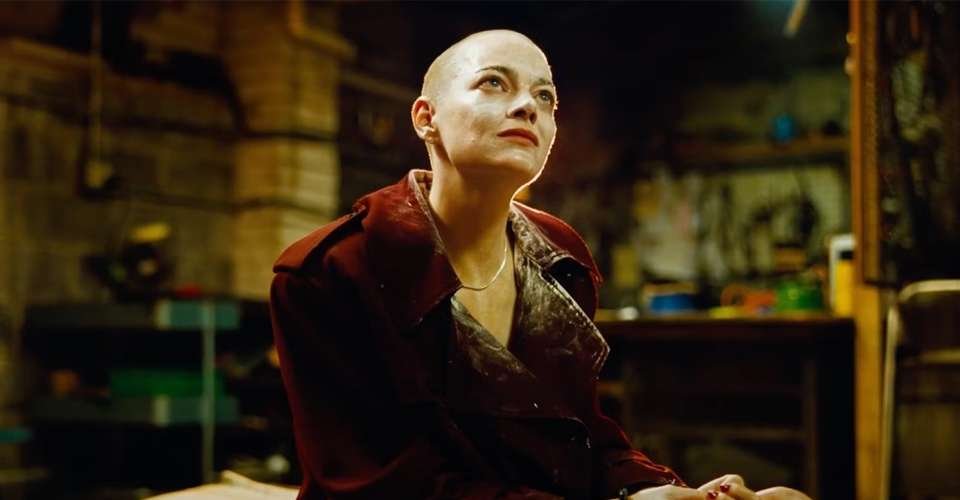
Emma Stone plays Michelle, the mysterious and woman Teddy becomes convinced is an alien infiltrator bent on destroying Earth. Stone imbues Michelle with a calm, controlled presence that keeps both Teddy and the audience constantly guessing. There’s a subtle ambiguity in her performance that makes it easy to understand why Teddy fixates on her. At times, she appears genuinely vulnerable and human. At others, there’s a distant quality in her eyes that suggests something unreadable beneath the surface. Stone walks this tightrope beautifully, never tipping too far into obvious villainy or innocent victimhood.
Aidan Delbis’ Don serves as an important counterbalance in the narrative, grounding several moments in a more recognizably human reality. Don’s interactions with Teddy offer glimpses of what life might look like outside the spiraling paranoia, making Teddy’s descent feel even more tragic. Delbis brings a natural warmth to the role, and while Don isn’t given as much screen time as the two leads, his presence adds emotional texture and perspective to the story.
Much of Bugonia’s strength lies in its dialogue-driven scenes, particularly those between Teddy and Michelle. The film often slows down to allow long conversations to unfold, and these moments are where it truly shines. The writing crackles with tension as Teddy’s frantic logic clashes with Michelle’s composed responses. Some of the best scenes involve nothing more than the two sitting across from each other, talking, as the power dynamic shifts back and forth. Teddy may believe he has uncovered the truth, but Michelle frequently seems one step ahead, whether through intelligence, manipulation, or simple emotional control.
Director Yorgos Lanthimos crafts these exchanges with remarkable patience. Rather than relying on jump scares or shocking reveals, the film builds unease through words and expressions. A raised eyebrow, a pause before answering a question, or a slight change in tone can feel just as impactful as any explosive moment. It’s a refreshing approach in a genre that often leans too heavily on spectacle.
Visually, Bugonia matches its psychological intensity with a muted, almost claustrophobic aesthetic. The color palette is dominated by cold blues, grays, and shadowy interiors that reflect Teddy’s isolating worldview. The camera frequently lingers close to faces, forcing the audience to sit with the characters’ emotions. There’s a sense that we are trapped inside Teddy’s mind, seeing the world as he does, where every glance could be a clue and every silence a threat.
The film’s pacing is deliberate but rarely dull. While some viewers might wish for more traditional action or overt plot twists, the slow burn serves the story well. Each scene feels purposeful, steadily building toward an inevitable confrontation between belief and reality.
Not every narrative thread, however, lands as effectively. Stavros Halkias appears as a police officer whose expanded backstory is introduced partway through the film. While Halkias delivers a solid performance, the attempt to deepen his character with a past attachment to Teddy, feels forced and oddly out of place within the larger story. The sudden shift in focus disrupts the film’s otherwise tight psychological momentum, and the emotional weight of his backstory never fully integrates with Teddy’s central arc. Rather than enriching the narrative, it comes across as a distraction that the film didn’t truly need.
Where Bugonia ultimately stumbles is in its conclusion. Without giving away specifics, the final act takes a turn that feels disconnected from the emotional and thematic groundwork laid throughout the film. After spending so much time carefully developing the characters and their psychological journey, the ending seems to betray that investment. Rather than feeling like a natural culmination of Teddy’s descent or Michelle’s mysterious presence, it arrives as a sharp pivot that reframes the story in a way that diminishes what came before.
It’s not that the ending is inherently shocking or poorly executed on a technical level. In fact, it will likely spark plenty of conversation. The problem is that it ultimately renders much of the film’s emotional journey meaningless. The careful buildup of tension, the nuanced performances, and the intricate dialogue all feel undercut by a conclusion that appears more interested in subversion than in honoring the narrative’s internal logic.
Still, the journey itself is undeniably compelling. For most of its runtime, Bugonia is a gripping exploration of paranoia, obsession, and the human need to impose meaning on chaos. It taps into modern anxieties surrounding misinformation and conspiracy culture, making Teddy’s descent feel disturbingly plausible.
Plemons and Stone elevate the material with performances that are restrained yet powerful, and Lanthimos’ direction ensures that even the quietest moments pulse with unease. While the film may not stick its landing, it remains a bold and memorable experience that lingers long after the credits roll.
Gordo’s Score: 8/10