Sometimes the best way to fight the future is not to understand it, but to survive it long enough to try again.
There is something refreshing about a filmmaker returning after a long absence and immediately reminding audiences why their voice mattered in the first place. With Good Luck, Have Fun, Don’t Die, director Gore Verbinski delivers a wildly inventive, high concept science fiction comedy that feels both chaotic and controlled, absurd and thoughtful, and above all unmistakably his own.
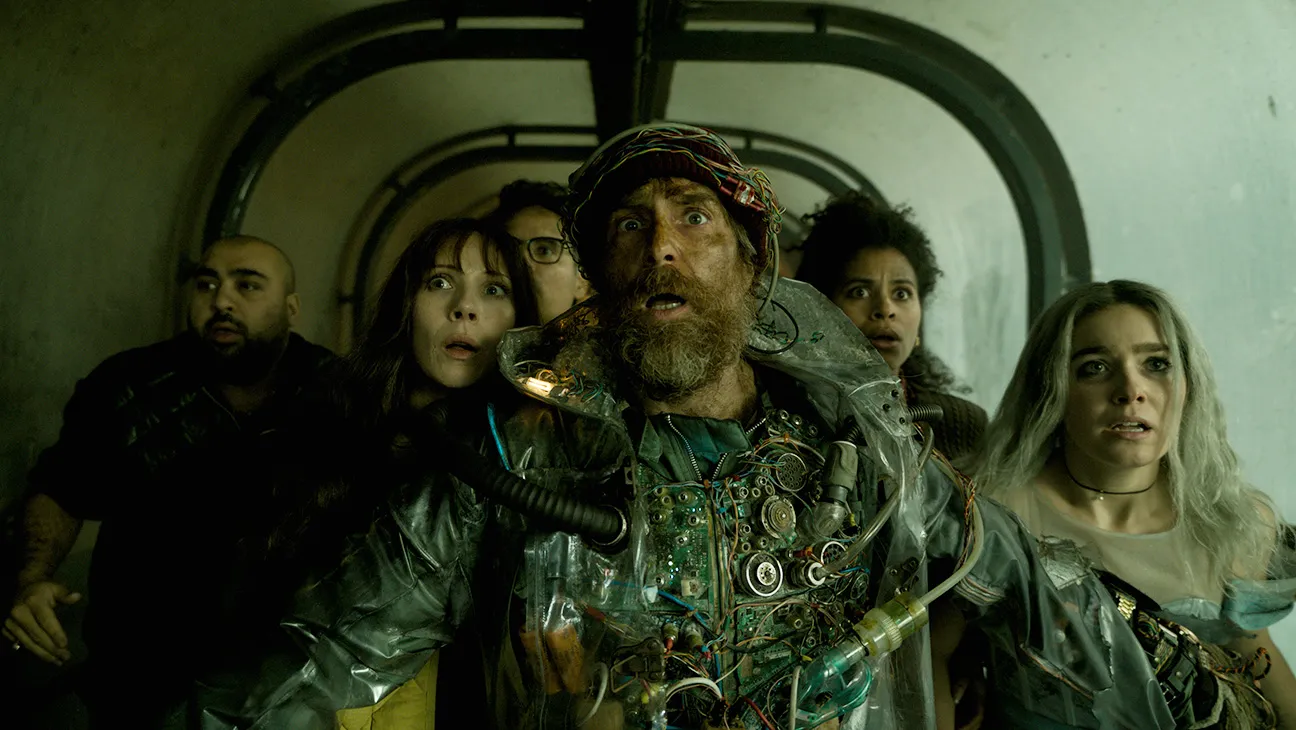
At its core, the film is deceptively simple. A frantic man from the future, played with electric unpredictability by Sam Rockwell, storms into a Los Angeles diner and attempts to recruit a group of unsuspecting strangers into a mission to stop an impending AI apocalypse. It is a premise that sounds like it could collapse under its own ambition, but instead it becomes the perfect vehicle for Verbinski to explore larger ideas about inevitability, control, and the illusion of choice, all while maintaining a sense of humor that keeps the film from ever becoming overly serious.

Rockwell is the engine that drives the entire experience. His performance walks a razor thin line between comedic absurdity and genuine urgency. One moment he is delivering rapid fire exposition like a man who has lived this nightmare a thousand times, and the next he is barely holding himself together, convincing both the characters and the audience that the end of the world is not just coming, it is already in motion. It is the kind of performance that could easily tip into caricature in the wrong hands, but Rockwell grounds it just enough to make the chaos feel purposeful.
The supporting cast, including Haley Lu Richardson, Michael Peña, Zazie Beetz, and Juno Temple, brings a lived in authenticity to what could have been purely archetypal roles. Each character begins as a recognizable type, the skeptic, the reluctant participant, the believer, but as the film progresses their interactions begin to feel less like plot mechanics and more like a group of ordinary people grappling with extraordinary circumstances. That grounded humanity is crucial because it gives the film emotional weight beneath its high concept surface.
Stylistically, Good Luck, Have Fun, Don’t Die sits somewhere between the bureaucratic nightmare of Brazil and the philosophical framework of The Matrix, but it never feels derivative of either. Where The Matrix presents its ideas with sleek precision and mythic clarity, Verbinski’s film is intentionally messier, more frantic, and far more comedic. And where Brazil leans into suffocating systems and dark satire, this film injects a sense of momentum and unpredictability that keeps it constantly moving forward.
What sets it apart is its willingness to embrace that chaos as part of its identity. The film does not hold the audience’s hand, nor does it pause to over explain its rules. Instead, it trusts viewers to keep up, to piece things together, and to accept that not every question will have a clean answer. That approach may alienate some, but for those willing to engage with it on its own terms, it becomes part of the experience rather than a barrier to it.
One of the film’s greatest strengths is how it uses humor to disarm its darker themes. The idea that an AI system could not only predict human behavior but manipulate it to maintain control is inherently unsettling. Yet Verbinski filters that concept through absurd situations, awkward interactions, and moments of almost surreal comedy. The result is a tone that feels uniquely balanced, never trivializing its ideas, but never allowing them to become overwhelming either.
Visually, the film reflects this same balance. It is not interested in the glossy, hyper polished aesthetic often associated with modern science fiction. Instead, it embraces a slightly off kilter, grounded look that makes its world feel both familiar and just a little wrong. That subtle unease permeates the entire film, reinforcing the idea that something beneath the surface is not quite as it seems.
As the narrative unfolds, the film gradually reveals that the mission at its center may not be as straightforward as it initially appears. Without giving too much away, the story leans into the idea that success and failure may be part of a larger, repeating cycle, one that the characters may not fully understand. It is a bold choice, and one that elevates the film beyond a standard save the world narrative. Rather than offering a clean resolution, it leaves the audience with something more interesting, a lingering question about whether control is ever truly within reach.
If there is a critique to be made, it is that the film occasionally risks overwhelming itself with ideas. There are moments where the exposition comes quickly, and the pacing can feel relentless. But even in those moments, there is an energy and confidence that keeps the film engaging. It may not be perfectly streamlined, but it is consistently compelling.
Ultimately, Good Luck, Have Fun, Don’t Die is the kind of movie that feels increasingly rare, a mid budget, original science fiction film driven by a distinct directorial voice. It does not rely on franchise recognition or familiar formulas. Instead, it takes risks, embraces its quirks, and trusts its audience to go along for the ride.
For viewers looking for a clean, easily digestible story, this may not be the film they expect. But for those willing to engage with something a little stranger, a little more chaotic, and a lot more ambitious, it offers a rewarding experience that lingers long after the credits roll.
And in a cinematic landscape increasingly dominated by safe choices and predictable outcomes, that alone makes it worth seeking out.
Gordo’s Score: 9.5/10