In giving voice to those the city overlooks, Mraovitch reminds us that the smallest acts of connection can cut through even the deepest shadows. His films suggest a simple truth: when we choose to see one another fully, the darkness never stands a chance.
Stevan Lee Mraovitch is a filmmaker drawn to the people most of us pass without seeing. His newest feature, Where There Is Love, There Is No Darkness, moves far beyond the sleek postcard images of Paris to explore the hidden lives of migrant delivery workers, the global forces that push them across oceans, and the intimate friendships that help them survive once they arrive.
Coming off a festival-winning run with Doctor, Doctor, Mraovitch shifts into a more grounded, emotionally charged mode, crafting a story that blends political realities with spiritual depth and human tenderness. In this conversation, he breaks down the research, aesthetic decisions and personal relationships that shaped the film, revealing how a story about exploitation becomes, ultimately, a story about faith, connection and shared humanity.

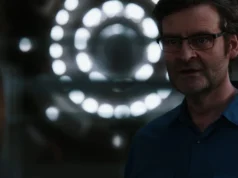
He appears in the new movie, Where There Is Love, There Is No Darkness. You can read our review of Where There Is Love, There Is No Darkness here.
INFLUX: Your most recent feature, Where There Is Love, There Is No Darkness, tells quite a complicated story. How did this story develop?
Mraovitch: The film started from a feeling of injustice. In Paris I kept seeing delivery workers everywhere, at all hours, in the rain and the cold. When I realized that many migrants without proper legal papers have to rent accounts from citizens who can legally open them, and that the migrants only receive a fraction of what they earn, it felt like a very quiet kind of violence. It is a deeply exploitative system that, in many ways, resembles modern-day servitude.
We should not forget that during the pandemic delivery workers were the ones saving us, bringing food while the rest of us stayed home, and now they have become invisible again. We see the backpack and the bike, not the person.
Seydou is a fictional character, but I wanted him to be rooted in real global forces. I started with the idea of a fisherman from Senegal and asked myself why he would leave his sea, his home and his pregnant wife to end up on a bike in Paris. That question led me to research the impact of industrial overfishing by foreign fleets in West Africa and how it destroys local economies, pushes people to migrate and then traps them in precarious platform work in Europe. I wanted to understand the whole chain, not just the final image of a rider at a red light.
The emotional core came from my long friendship with Oumar Diaw. His Muslim faith and inner calm have always fascinated me, because I come from a much more secular background. I wanted to portray that spirituality with real detail and tenderness, and then put it in conversation with Albert, an elderly atheist Parisian who is grieving his wife. Their unlikely friendship turns a political story about migration and work into something much more intimate, about love, grief and the way two very different men save each other.
INFLUX: This is a significantly different movie in tone and style than Doctor, Doctor. How did you decide on the look and feel of this movie?
Mraovitch: Doctor, Doctor lives in a very stylized world, with bold colors, precise framing and a strong influence from Molière, Wes Anderson and the Coen brothers. It is big, playful and theatrical on purpose.
For Where There Is Love, There Is No Darkness I wanted something almost opposite: quiet, intimate and very grounded.
With Yvan Angelo Rodionov, my director of photography, we chose to shoot in 4 by 3. That format physically confines Seydou inside the city and keeps the camera close to his face, which creates a feeling of pressure. It also limits the way the audience can see Paris. You no longer get wide postcard views, only fragments, which is exactly how the characters experience the city. Their access to the beauty of Paris is very restricted, so the viewer’s access is restricted too. We leaned on natural light to heighten reality, with cold, indifferent streets and warmer interiors for moments of connection, so that the form always follows Seydou’s emotional journey.
INFLUX: What was the casting process?
Mraovitch: Seydou was written for Oumar Diaw from the beginning. I knew he could carry the film with his physical presence, his emotional range and his real life experience as a devout Muslim, which allowed us to show a spiritual life that feels true and nuanced.
For Albert I dreamed of Albert Delpy and I was very lucky that he said yes. He is an icon of French cinema, known for films like 2 Days in Paris and 2 Days in New York, and he brings a natural mix of humor, grumpiness and heartbreak to the role.
With our casting director Aïssata Diaw Niang we completed the world using both professional actors such as Laïd Liazid, Jean-Paul Dix, Emma Chaibedra, Jean-Claude Tran and Qingwei Kong, and people from the Senegalese and West African communities around Paris. Two of the Senegalese actors are actually Oumar’s cousins and complete non-actors, which adds a real family energy to their scenes together.
INFLUX: Tell us about the locations, which are almost a character themselves. Where did you shoot the movie? How did you secure the locations?
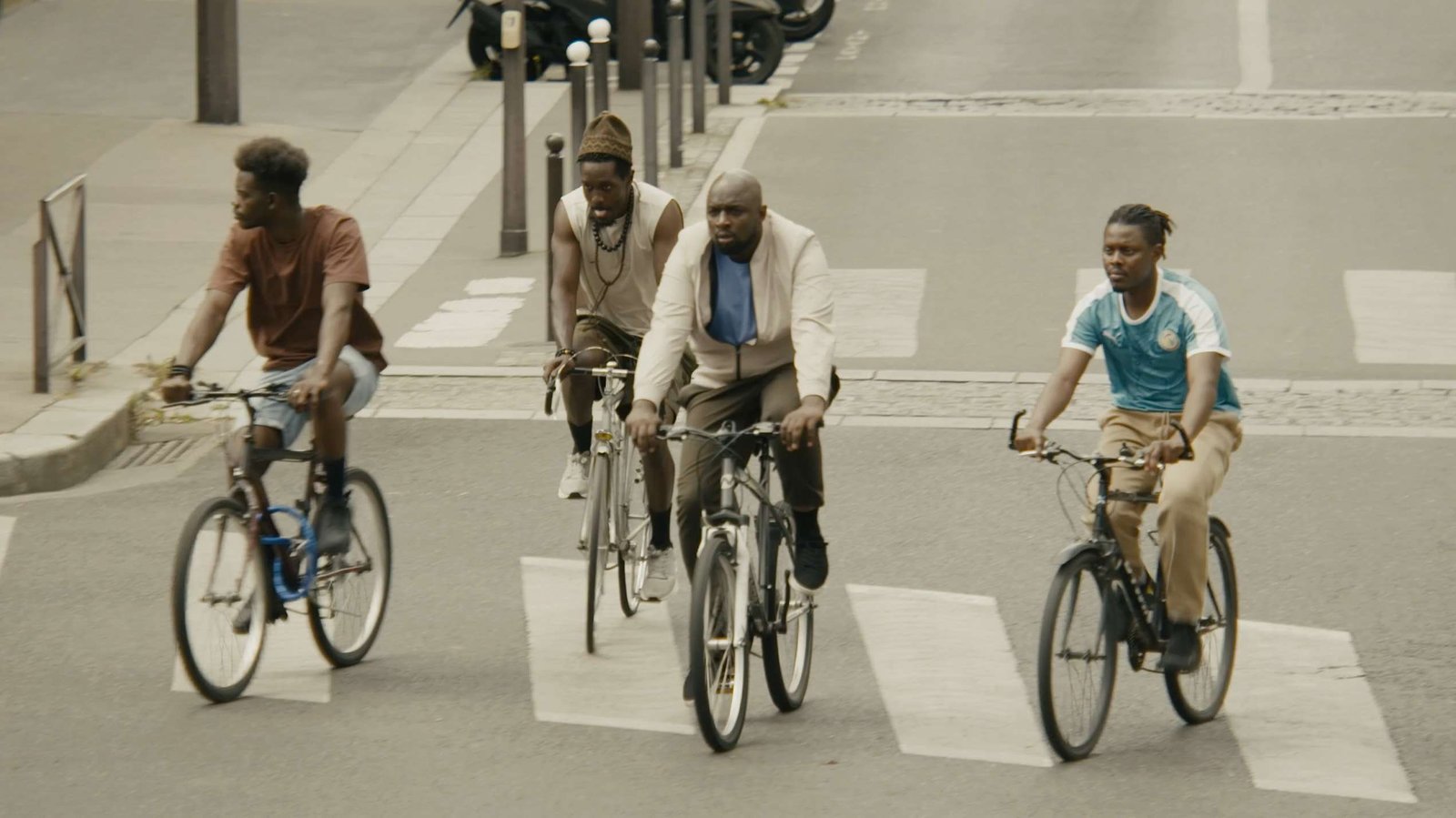
Mraovitch: We shot in Paris and its close suburbs, mainly Alfortville and Maisons-Alfort. I wanted to show the Paris that delivery workers really see: big housing blocks, underpasses, ring roads, tiny rooms where several people share the same space. The film constantly moves between a hidden Paris and the postcard city tourists know, which mirrors Seydou’s own position, both inside and outside the city at the same time.
It was a very difficult period to shoot because of the Olympics. Many public areas were restricted or incredibly complicated to access, so we had to rely heavily on privately owned locations. One key neighborhood was Les Olympiades, whose elevated plazas and brutalist architecture fit the tone of the film and where we managed to secure permits. Only later did I fully appreciate the irony: Les Olympiades was originally built as a tribute to the Olympic Games, with each tower named after a host city. So during the Paris Olympics, we ended up shooting our film in a neighborhood literally conceived in homage to them. And the greatest irony is that Les Olympiades is privately owned, which made getting permits there far easier than in most public spaces.
Finally, the place where the four friends meet is at the confluence of the Seine and the Marne, beneath an industrial complex called Chinagora, a huge Chinese restaurant surrounded by a striking Chinese-inspired building. For me, that spot was incredibly symbolic. Since our characters are fishermen from Africa, the meeting of the two rivers felt like a simple but powerful metaphor for two worlds joining together, Europe and Africa, and for their past on the water flowing directly into their present in this new city. And the meaning becomes even stronger knowing that many West African fishermen who reach Europe have been transported by smugglers using Chinese fishing vessels. That reality gave the location a haunting resonance that I could never have invented.
INFLUX: On screen, the characters have a clear connection. Was there a connection off screen with the actors as well?
Mraovitch: Yes, and I think you really feel it. With Oumar there is already a long friendship and creative partnership, so he trusts me when I ask him to go to difficult emotional places and I trust him completely with the character. That makes it possible to explore vulnerability safely.
Between Oumar and Albert Delpy we spent time simply being together in the apartment, not just rehearsing scenes but talking about life, politics, Senegal, France, faith and grief. That created a real comfort between them that you can sense when they are just sitting on the sofa. For the younger group, the family feeling was immediate, especially because two of the actors are Oumar’s cousins and had never acted before. The camaraderie you see among the four friends, the teasing, the exhaustion, the way they share space, is very close to how they were when the camera was not rolling.
INFLUX: Where There Is Love, There Is No Darkness gives off the impression of an in depth pre production process. How long and how were you prepping before shooting?
Mraovitch: The formal pre-production lasted a few months, but the research started years earlier. I spent a lot of time reading about the platform economy and about industrial overfishing in Senegal and West Africa, and I also interviewed migrant workers and people involved in support organizations to understand their reality from the inside, not just from statistics.
Once we had dates, the focus was on geography, routine and intimacy. With Yvan-Angelo we walked and biked Seydou’s routes at different times of day to see how the light would behave in the 4 by 3 frame. We rehearsed in the actual rooms and underpasses to make sure the blocking felt natural in such tight spaces. With Oumar we worked on Seydou’s rituals, especially prayer, and with the art and costume departments we planned small evolutions of objects and clothes so that you feel time passing and fatigue building. All of this preparation was essential, because the shoot itself was very short and intense.
INFLUX: How long was the shoot? Was it shot consecutively or broken up? What were the reasons for these choices?
Mraovitch: We shot the film in 15 days. That was partly a question of budget and partly due to what we could realistically obtain in terms of permits during the Olympic period. We could not lock the same areas for three straight weeks, so the schedule was broken into blocks, based on the specific windows when each location was available.
This meant that every shooting day was extremely dense, especially at night, and there was almost no room to improvise whole new sequences. We had to arrive very prepared, with performance arcs, camera choices and blocking already thought through. The advantage is that this intensity gave the film a certain tension that matches Seydou’s life, which is also about endurance and constant pressure.
INFLUX: What are your goals for Where There Is Love, There Is No Darkness?
Mraovitch: On a human level my goal is very simple. I hope the film changes the way people look at the workers they cross every day. If someone leaves the cinema and the next day looks differently at the rider in front of their building, with more respect and curiosity, that already means a lot to me.
More broadly I hope the film contributes to the conversation about migration, work and faith in Europe without being didactic. It is a political film, but it is told through the intimate relationship between Seydou and Albert, not through speeches. Ideally the movie continues to travel to festivals, cinemas and platforms in very different countries, so that people who may never have been to Paris or Senegal can still recognize something of themselves in these two characters.
INFLUX: What do you have lined up next?
Mraovitch: After a year of festival wins and international screenings with Doctor, Doctor and Where There Is Love, There Is No Darkness, I am focusing on writing again. I am developing several projects, including a socially charged Parisian comedy, a psychological thriller and a philosophical science fiction novel. The forms are different, but they all revolve around people who feel invisible or caught between worlds, which is clearly the thread that connects my work. The intention is the same in all of them: to tell stories that move people, spark thought and remind us of our shared humanity.
INFLUX: The meaning of the title: what does Where There Is Love, There Is No Darkness mean to you?
Mraovitch: The title comes from an African proverb, often attributed to Burundi, that I loved as soon as I discovered it, because it felt like a perfect description of Seydou’s story. From the outside his life looks very dark. He is exploited, far from home, living in an overcrowded room in a city that hardly acknowledges his existence. Yet he is surrounded by different forms of love: his love for his wife and unborn child, his ties to his family in Senegal, his spiritual love in the form of faith and the unexpected affection that grows between him and Albert.
For me the title says that darkness is not only about external conditions. It is also about the absence of connection. Seydou can endure because he stays attached to people, even across distance. Memory, faith and friendship keep him from collapsing. The same is true for Albert. Materially he is fine, but emotionally he lives in the dark after the loss of his wife. When Seydou comes into his life and they start to care for each other, the world around them does not magically change, but the light returns inside them.
There is also a spiritual dimension. Seydou’s faith is not treated as a problem or a cliché. It is shown as an inner light, a way for him to keep his dignity when the outside world is indifferent or hostile. At the same time the film shows that love can take many forms, religious or secular, romantic or paternal, rooted in family or in friendship. Wherever that kind of love exists, there is at least a chance to resist despair. That is what the title means to me.
INFLUX: Why did you choose the 4 by 3 aspect ratio?
Mraovitch: We chose 4 by 3 very early, because a wide panoramic format would automatically turn Paris into a postcard, and that is not what Seydou sees. He does not stroll along the Seine admiring monuments. He sees doorways, traffic lights, underpasses and phone screens. The narrower frame breaks the city into fragments, which correspond to his lived experience.
On an emotional level 4 by 3 lets us stay very close to the characters. You are often right up against Seydou’s face, sharing his fatigue, doubt and small moments of joy. The frame becomes like a box that reflects the constraints of the immigration system and the platform economy. It also limits the audience’s access to the beauty of Paris in the same way the characters’ access is limited. You get glimpses rather than the full panorama.
There is one more effect that I like. 4 by 3 is associated with older cinema and with portrait photography, so it naturally places the emphasis on human beings rather than spectacle. That felt right for this story, which is really about faces, hands and glances, all the small details that make up an apparently invisible life.