
Boston International Film Festival
April 11-21, 2014
AMC Theaters (all screenings)
175 Tremont st. Boston Common
BIFF will be bring film’s from around the world to screen in the city that represents America’s birthplace. Boston has been a city used for Oscar-winning films in the last 15 years made by legendary directors Gus Van Sant (Good Will Hunting), Clint Eastwood (Mystic River) Martin Scorsese (The Departed) and David O. Russell (The Fighter). It is a suiting a city so rich in American and Film History hosts films in all genres from China, The U.K., Canada, Denmark and many other countries spanning the globe.
One of the many great films playing the Boston International Film Festival is Missing Child. The film co-stars and co-written, co-produced, directed by Luke Sabis.
Missing Child follows the journey of Gia (Kristen Ruhlin), a young woman in her 20s, with a troubled past. Having never met her natural parents, Gia was raised in foster care where she experienced physical and sexual abuse as a young girl, which lead to many unhealthy experiences and relationships in her teenage years. Now, Gia tries to put her past behind, focusing on her ambition to return to school and pursue a degree in fashion design.
Gia’s goal is interrupted when she discovers, through her boyfriend Joe (Luke Sabis), an age-progressed photo of a missing child, who resembles herself. Her friend Debbie (Jennifer Straley), a single mother going through her own financial troubles, is concerned that Gia is repeating unhealthy habits by being with her boyfriend Joe, who is nearly twice Gia’s age. Gia however, develops a stronger bond with Joe, who is very supportive of Gia’s desire to learn of her roots.
Gia and Joe drive to the house of Henry Whittle (Charles Gogano), the man they believe may be Gia’s father. Though he is wary of visitors who claim to be, or to know about his missing daughter, Henry welcomes them into his home. He takes a liking to Gia but views Joe with distrust. Gia looks at old photos of Henry’s missing daughter and sees a discrepancy that makes her believe that she is not Henry’s daughter. Joe encourages her not to give up hope.
While having dinner, Henry reveals to Gia and Joe, he believes that Gia is his daughter. He produces a bag of cash as a reward for the return of his daughter. Gia is infuriated as she learns that Joe has been planning all of this in an effort to swindle Henry out of this reward money. Joe expresses a more violent side and warns Gia not to get in the way of his plan, or he will cause harm to Henry.
As the evening progresses, Gia and Joe become disoriented and Henry takes on a darker tone. It becomes clear that Henry has drugged Gia and Joe as the two become incapacitated. Gia and Joe pass out.
Gia and Joe lie shackled in the living room. They awaken to see Henry sitting nearby in a rocking chair, viewing them with disgust. Henry expresses a devout religious side. With a shotgun in his hands, he stands over Joe, condemning him for trying to make Henry believe Gia is his daughter.
Henry shifts his attention to Gia, who he considers equally responsible. She reveals a spiritual side which angers Henry. He denounces Gia for being a heathen. She fights back by revealing her past sexually deviant behavior. He responds by dragging Gia into his missing daughter’s bedroom.
While captive, Gia draws a connection between this violence, and the violence and abuse of her own childhood. She begins to identify with Henry’s missing daughter.Henry exposes a mentally twisted and unbalanced side. He becomes more malicious in his treatment of Gia and Joe. He threatens Joe physically, and then he threatens Gia physically and sexually. Gia questions Henry about his relationship with his daughter. He confesses that he had abused her. It becomes clear to Gia that his abuse had gone further than she ever could have imagined…
Review of Missing Child
Missing Child is brilliant, unique and one big box treasure of twists and turns. Missing Child is loaded with themes, social issues and moral questions that plague our society and leave the audience wondering “In room full of flawed characters, who do we root for?” I like this film because it did not short change us with over acting or cheap indie-film gimmicks.
The editing was perfect and the pace of the film let the story unfold, the director never rush any of the film’s best moments. It is enjoyable when a director invites you into his vision, too many films are self-absorbed these days. Missing Child is the exact opposite. What movies need are more films like this willing to take a chance and (if need be) make the audience uncomfortable. Like Sabis did an excellent job as a writer, producer, director and actor.
Paul’s Grade: A
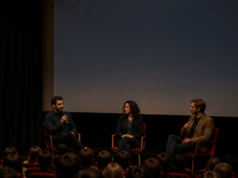
A Q&A with Luke Sabis, where the director shares his thoughts about his film, filmmaking and life experience.
Paul Booth: Please explain your inspiration and point of view when you first started developing and collaborating on Missing Child and why you made this film. How or what prompted the idea for your film and how did it evolve?
Luke Sabis: At the end of 2006, I had just gone through the cinema program at Los Angeles City College. While there, I made a few shorts but I was interested in making a feature film. Looking through my mail, I had seen a lot of Missing Child listings inserted on various pieces of junk mail, such as ads for dry cleaners and other local businesses. I read through a number of them on a daily basis. I found these stories about missing people to be upsetting, imagining how a parent or family, torn apart and thrown into chaos and uncertainty, deal with such a horrific event. The majority of the cases seemed to be about a child who had gone missing recently, within the past year or two, but the cases that intrigued me most were that of children who had disappeared as far back as 20 plus years ago, and are still considered missing. These cases seemed especially heartbreaking to me, when a family is forced to live without any resolution to an unspeakable crime.
One such case involved someone by the name of, “Danyel Lou Sparpana” who had gone missing at the age of three years and four months, back in 1985, and she is still considered missing. Taking that lone fact, I began outlining the story for, “Missing Child.” When I began working on the script, I had just gotten out of a relationship and I was spending a lot of time alone. The film deals with themes of isolation and solitude, and characters who are disconnected from each other. It reflected what I was going through in my own personal life, at the time.
PB: What inspired you to become a filmmaker? Please explain your history in filmmaking.
LS: My earliest artistic endeavors involved writing songs and playing guitar for my Rock band, “The Take” in New York City. I continued my stage career in New York as an actor on the Off Broadway stages. Soon after, I moved to Los Angeles pursuing acting work. To help pay the bills, I worked as a part-time massage therapist at the Burke Williams Day Spa in Hollywood. For a time, I focused on auditioning for commercials. It wasn’t my passion but I asked myself, if I made enough money acting in commercials, and I didn’t have to worry about a day job, what would I do with my time? It was clear to me I wanted to make films. Filmmaking was a way for me to use all the artistic skills I had developed in my life, including writing, playing music and acting.
My only problem was I still wasn’t making any money doing commercials. Being raised in Queens, my New York accent and mannerisms always seemed to surface and contradict my mid-western American appearance, which did not work in my favor in the commercial world. Regardless, I knew what I ultimately wanted to do so I enrolled in the Cinema Program at the very affordable Los Angeles City College. While at LACC, I maintained an “A” average, enjoying every minute of my studies there.
PB: What do you want the audience to ‘take away’ after they have seen the film.
LS: The main characters of Missing Child are not necessarily easy to root for. They all have something in their past, or present, that is somewhat unsavory. Most of us have made bad decisions or have taken wrong turns at one time or another. I hope audiences will be on Gia’s side as she navigates through a series of twists and potentially harmful turns, fighting to live another day and being better off for it. I want audiences to see an underlying optimism in what is otherwise an ugly world that Gia has fallen in to.
PB: What was your biggest challenge in developing or producing this project?
LS: As is common in many indie films, getting money had been a challenge in the early stages of the project. It made it slow in the beginning and dragged out the overall time to complete the film. We weren’t fully financed at the start so a lot of pieces to the puzzle of making a film were not in place. For example, upon completion of principal photography, we didn’t have any of our post-production team in place. This was not the most efficient way of making a film but as we moved along, we picked up more momentum and things fell into place.
PB: What is the most important message in this film to you?
LS: What I wanted to show in Missing Child was that to a great extent, for better or worse, we are responsible for where we end up in our life.
Screening of Missing Child:
Sunday April 13th, 12 p.m. at AMC Theaters. 175 Tremont st. Boston Common
For more information visit www.bifilmfestival.com
Article by Entertainment Writer, Paul Booth