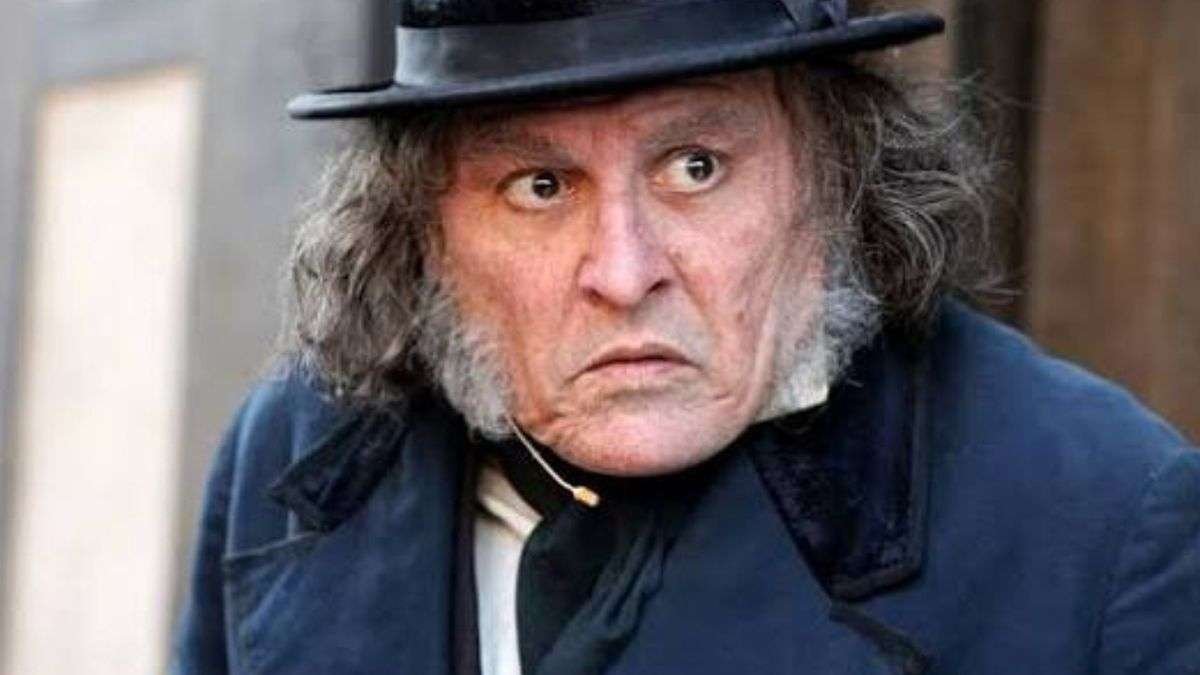

Ti West’s atmospheric direction and Johnny Depp’s layered performance make this adaptation a haunting yet heartfelt addition to the long legacy of Dickens’ holiday classic.
We all know the story of Charles Dickens’ A Christmas Carol. Whether you first met Ebenezer Scrooge through the pages of Dickens’ novella or via one of the many film and television adaptations, from A Muppet Christmas Carol to the irreverent Scrooged, the tale of redemption on a snowy Christmas Eve is a cinematic staple.
With director Ti West at the helm and Johnny Depp donning Scrooge’s nightcap, this latest adaptation aims for something distinct: a faithful retelling with a horror-adjacent edge, offering chills without ever tipping fully into terror. The result is a film that stands out, even in a crowded field of Christmas Carol adaptations.
Set in the shadowy, gaslit streets of Victorian London, A Christmas Carol follows the miserly Ebenezer Scrooge (Johnny Depp) on his journey from bitter misanthrope to a man transformed by the spirits of Christmas. The familiar supporting cast is here: the long-suffering Bob Cratchit (Rupert Grint), Scrooge’s affable nephew Fred (Sam Claflin), and the ethereal trio of Christmas ghosts. Ian McKellen appears as the tormented Jacob Marley, while Andrea Riseborough brings an unsettling presence to the Ghost of Christmas Past. Daisy Ridley rounds out the cast as Clara, a newly imagined character who brings warmth and nuance to the Cratchit family dynamic.
West’s adaptation does not stray far from the narrative bones of Dickens’ original. Scrooge’s greed and cruelty are put on display early, his disdain for the holiday and the people around him fueling the gloom that hangs over his counting house.
The arrival of Marley’s ghost sets in motion a night of supernatural visitations, each intended to strip away Scrooge’s defenses and confront him with the consequences of his choices. While the story’s arc is familiar, the execution feels fresh, and at times, genuinely eerie.
What makes this version of A Christmas Carol compelling is its willingness to embrace the story’s darker undercurrents without abandoning the hope at its core. Ti West, best known for his work in horror, walks a careful line. There are legitimate scares here, but they serve the narrative rather than overwhelm it.
The spectral apparitions are hauntingly realized, with practical effects and shadowy cinematography that recall classic ghost stories. The film never becomes a horror film outright, but it flirts with the genre’s aesthetics: flickering candlelight, chilling sound design, and a persistent sense of unease that lingers even in moments of sentimentality.
Johnny Depp’s performance as Scrooge is a revelation. In the early scenes, he is utterly detestable. His Scrooge is gaunt, sharp-tongued, and almost reptilian in his movements. Depp leans into the character’s flaws, making his eventual transformation all the more affecting. When Scrooge’s icy exterior begins to crack, Depp finds both vulnerability and sincerity, selling the redemption arc without tipping into schmaltz. It is a nuanced turn that anchors the film.
The supporting cast is equally strong. Rupert Grint’s Bob Cratchit is earnest and quietly resilient, giving the film a beating heart. Ian McKellen, as Marley’s ghost, delivers a performance that is both grand and deeply unsettling.
His scenes are some of the film’s most memorable, thanks in part to West’s willingness to let the supernatural elements linger. Andrea Riseborough’s Ghost of Christmas Past is ethereal and enigmatic, her presence both comforting and chilling. Sam Claflin brings warmth and humor to Fred, while Daisy Ridley’s Clara, though a new addition, feels right at home, providing a fresh perspective on the Cratchit family’s struggles.
Visually, the film is a triumph. The production design captures the grimy beauty of Victorian London, with fog-drenched streets and candlelit interiors that evoke both coziness and menace. Cinematographer Eli Arenson, whose previous credits include atmospheric indie horror, uses shadow and light to great effect, heightening the film’s sense of mystery.
The musical score, by composer Mark Korven, weaves traditional carols with eerie, discordant motifs, underscoring the film’s tension between darkness and hope.
Technically, A Christmas Carol is impressively crafted. The practical effects, particularly in the ghostly visitations, are inventive, and the editing maintains a brisk pace without sacrificing character moments. West’s direction is confident, balancing the story’s emotional beats with its more frightening set pieces.
The film’s tone is perhaps its most impressive achievement. It is never cynical, and it refuses to indulge in easy sentimentality. Instead, it finds genuine emotion in Scrooge’s journey, making the familiar story feel urgent once again.
This new adaptation of A Christmas Carol may not be the definitive version, and it never quite achieves the joyful irreverence of Scrooged or the heartfelt charm of A Muppet Christmas Carol, but it does something rare: it finds new life in a story we all know by heart. With strong performances, striking visuals, and a willingness to embrace the story’s darker themes, Ti West and Johnny Depp have delivered a film that is both entertaining and thought-provoking.
Fans of Dickens, horror, and holiday tales alike will find much to appreciate here. It is not a masterpiece, but it is no disappointment either, and in a landscape crowded with Christmas adaptations, that is an achievement worth celebrating.
SCORE 8.0/10