Superman Lives has become a Hollywood legend, a mystical “what if” but we will never know what could’ve been because this movie was never made.
By Rob Shields
Imagine this.
It’s the late nineteen-nineties.
Tim Burton, the filmmaker who reinvented Batman for the big screen, is making a Superman movie.
Superman has long hair.
Christopher Walken might play Brainiac.
Superman’s costume lights up.
At one point, Superman doesn’t even have his traditional powers.
And playing the Man of Steel is Nicolas Cage.
Yes.
Nicolas Cage.
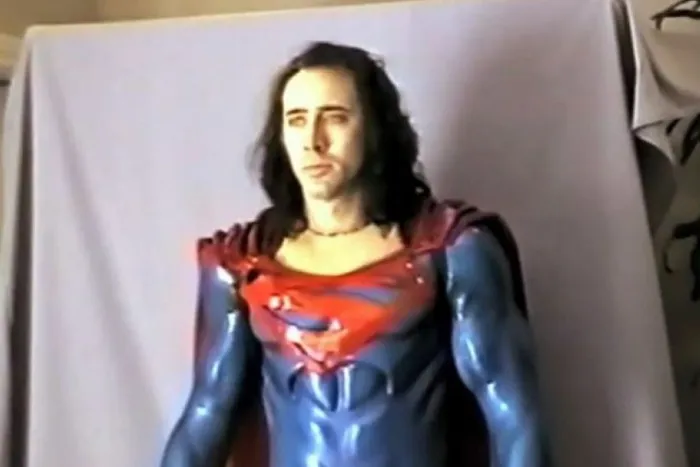
Today, pictures of Cage wearing Superman costumes have become some of the most famous images of an unmade movie in Hollywood history.
But those photographs only tell a tiny part of the story.
Because Tim Burton’s Superman Lives wasn’t simply an idea somebody pitched and abandoned.
Warner Bros. spent years developing it.
Scripts were written.
Costumes were created.
Sets were designed.
Nicolas Cage was cast.
Tim Burton was hired.
And Warner Bros. intended to release the movie in 1998.
Then the entire thing collapsed.
By the mid-nineteen-nineties, Superman had been missing from movie theaters for nearly a decade.
Christopher Reeve’s original Superman had helped create the modern superhero movie in 1978.
But by Superman IV: The Quest for Peace in 1987, the franchise was finished.
Meanwhile, Batman had become enormous.
Tim Burton’s Batman arrived in 1989 and became a cultural phenomenon. Batman Returns followed in 1992.
Warner Bros. wanted Superman back.
But this wouldn’t be Christopher Reeve’s Superman.
The studio wanted something new.
And after the enormous success of the comic book storyline The Death of Superman, the idea of killing and resurrecting Superman became central to the proposed movie.
Several writers attempted to crack the story.
Eventually, Warner Bros. brought in filmmaker and comic-book fan Kevin Smith.
Smith had recently made Clerks and Mallrats, and although he wasn’t exactly the obvious person to write a giant Superman movie, he knew the character.
He was given the opportunity to rewrite the project.
His version was called Superman Lives.
The basic idea involved Brainiac coming to Earth and working with Lex Luthor.
Superman would lose his powers, die fighting Doomsday, and eventually be resurrected with the help of Kryptonian technology.
But Smith’s involvement became legendary for another reason.
Producer Jon Peters reportedly had some very specific ideas about Superman.
According to Smith’s frequently retold account, Peters didn’t want Superman flying.
He didn’t want him wearing the traditional suit.
And Peters really wanted Superman to fight a giant spider.
Yes.
A giant spider.
Smith eventually delivered his screenplay.
But then the project landed a director.
And that director changed everything.
Nicolas Cage was already connected to the project when Tim Burton came aboard.
And suddenly, Superman Lives became something very different.
Burton wasn’t interested in simply translating the traditional Superman onto the screen.
That’s not particularly surprising.
His Batman hadn’t exactly been a faithful recreation of the comic-book version, either.
Burton was interested in outsiders.
Edward Scissorhands.
Beetlejuice.
Bruce Wayne.
Characters who didn’t quite belong in the world around them.
And that gave him an interesting way into Superman.
Instead of concentrating entirely on Superman as the ultimate symbol of confidence and strength, Burton was interested in Kal-El as an alien.
Someone who looked human but wasn’t.
Someone trying to understand where he belonged.
That concept also helped explain one of the strangest casting decisions in superhero history.
Today, Nicolas Cage playing Superman sounds like stunt casting.
In the nineteen-nineties, it wasn’t quite as strange as it sounds.
Cage was coming off an Academy Award for Leaving Las Vegas and entering his action-star period with movies like The Rock, Con Air, and Face/Off.
More importantly, Cage genuinely loved Superman.
He loved the character so much that he named his son Kal-El.
Still, Nicolas Cage didn’t look anything like the traditional square-jawed Superman audiences knew.
And that may have been precisely the point.
Burton wasn’t trying to remake Christopher Reeve.
Costume tests were performed.
Cage grew his hair long.
Several wildly different Superman suits were developed, including versions featuring metallic materials and illuminated elements.
Some test footage looked bizarre when still photographs first leaked online years later.
But watching the actual costume-test footage tells a slightly different story.
Some of it actually works.
It’s strange.
It’s unmistakably Tim Burton.
But you can begin to see the movie they were trying to make.
Kevin Smith’s screenplay wasn’t going to survive Tim Burton.
Burton brought in Wesley Strick, who had worked on Batman Returns, to rewrite it.
Later, Dan Gilroy would also work on the project.
The story continued changing.
One version involved Brainiac merging with Lex Luthor into a creature sometimes called Lexiac.
Superman’s death and resurrection remained central.
So did the idea of Superman confronting his identity as an alien.
Concept artists began creating Burton’s version of Metropolis.
Production designer Rick Heinrichs worked on the movie.
An art department was assembled.
The movie wasn’t merely being discussed anymore.
Superman Lives had entered pre-production.
Warner Bros. was spending real money.
And then reality arrived.
Warner Bros. had suffered several expensive disappointments during this period.
And Superman Lives was becoming an extremely expensive proposition.
The screenplay still wasn’t settled.
The budget was enormous.
The release date was becoming increasingly difficult to hit.
And the studio became nervous.
Eventually, Warner Bros. pulled the plug.
Tim Burton left the project.
Nicolas Cage never got to play Superman.
At least, not then.
And Superman Lives became one of Hollywood’s most famous unmade movies.
But what would it actually have been?
Would it have been good?
Maybe.
Would Superman fans have hated it?
Quite possibly.
Would it have been boring?
Almost certainly not.
Burton was coming off movies like Edward Scissorhands, Batman Returns, and Ed Wood.
Nicolas Cage was entering one of the most gloriously unpredictable periods of his career.
And the production artwork suggests something far stranger than the Superman movies Hollywood eventually made.
We probably wouldn’t have gotten the definitive Superman.
But we might have gotten one of the strangest superhero movies ever produced.
And there’s another interesting possibility.
If Superman Lives had succeeded in 1998, superhero movie history could have unfolded very differently.
This was before X-Men.
Before Sam Raimi’s Spider-Man.
Before the Marvel Cinematic Universe.
A successful Superman movie from Tim Burton could have pushed Warner Bros. toward interconnected DC properties years before Hollywood became obsessed with cinematic universes.
Instead, Superman remained absent from theaters until Superman Returns in 2006.
There is, however, a strange little epilogue.
Nicolas Cage eventually did get to play Superman.
He voiced the character in Teen Titans Go! To the Movies.
And decades after Burton’s movie collapsed, Cage appeared as an alternate Superman in The Flash.
And what was his Superman doing?
Fighting a giant spider.
Hollywood apparently has a very long memory.
But the Superman that Cage and Burton were actually creating remains locked in an alternate cinematic universe.
A strange Superman.
An alien Superman.
A Tim Burton Superman.
Maybe it would have been brilliant.
Maybe it would have been a disaster.
We’ll never really know.
Because Tim Burton’s Superman Lives remains The Movie We Never Saw.