At Barton Academy, the best conversations happen after class.
Alexander Payne’s The Holdovers earns its Christmas warmth by giving the least popular teacher at a boarding school a student who can give as good as he gets.
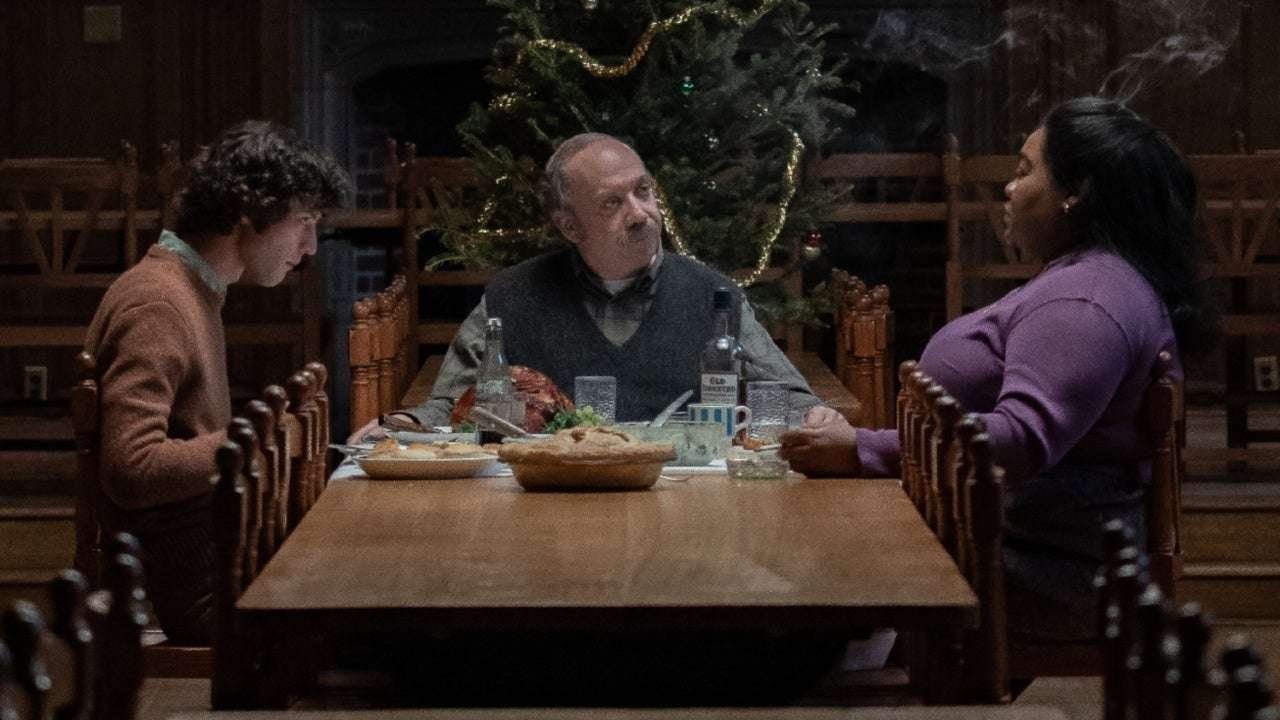
It’s December 1970 at Barton Academy in New England, and Paul Hunham (Paul Giamatti) has holiday duty. A handful of boys are staying on campus, and Paul, who teaches ancient history, sees no particular reason they should stop doing schoolwork. The story settles on Paul, one of those students, Angus Tully (Dominic Sessa), and the school’s head cook, Mary Lamb (Da’Vine Joy Randolph), whose son has died in Vietnam. Screenwriter David Hemingson gets a lot of mileage out of that shift in focus. It’s one thing to issue an unpopular order to a room full of boys. It’s quite another to sit down to dinner with a kid who resents it.
Giamatti makes a splendid nuisance of himself. Paul has a scholar’s vocabulary and the petty impulse to put precisely the right word to somebody else’s shortcomings. Half the fun is in how pleased he sounds to have found it. But Giamatti also conveys a genuine attachment to the things Paul teaches. Take the students away and he’d still want to talk about the ancient world; take the lectern away and he’d have a hard time figuring out how to start. His decision to assign work over Christmas is funny at the boys’ expense at first. As the break wears on, it starts to look like a fairly comprehensive account of his social life.
Sessa, in his film debut, gives Angus a lovely, awkward mix of sophistication and bad judgment. He’s often quick enough to spot the hole in Paul’s reasoning and rarely wise enough to leave it alone. What Sessa gets especially right is the difference between winning an argument with an adult and having any say in what happens next. Angus can sound like Paul’s equal right up until the moment he needs something from him. The shift brings out the boy in him without requiring him to turn suddenly sweet. These two make convincing adversaries, which is a considerable advantage once the movie starts asking them to be something else.
Then there’s Mary, for whom Barton is a workplace and Christmas is a stretch of time to get through without her son. Randolph has an ear for what deserves an answer. When Paul or Angus gets carried away, she can let him run out of steam rather than compete for the punch line. Her quiet has different shades, too: sometimes Mary appreciates the company, and sometimes being around people who expect her to be all right is its own kind of work. The script gives Paul and Angus more room to surprise each other than it gives Mary to pursue a life apart from them. Randolph makes that life seem substantial enough that another stretch in her company would have been welcome.
The period setting does more than supply the boys with the right haircuts. Barton prepares its students for a future they can reasonably expect to have, an assumption that sits uneasily alongside Mary’s loss. Payne lets that disparity register without turning every meal into a debate about privilege. He also gives the picture the slightly worn texture of a film that might have played in 1970. There’s an inviting softness to the winter light, though the empty school itself looks decidedly uncomfortable. A snow-covered campus makes a handsome Christmas card; it’s less appealing when everybody in the picture would rather be somewhere else.
The leisurely pace is mostly a pleasure. There’s time for a barb to land badly and for the person who delivered it to sit there with the result. Occasionally, especially as the characters begin explaining how they came to be so unhappy, the storytelling gets a little too tidy. A disclosure can feel like the answer to a question the actors have already answered more interestingly in passing. It’s hardly a mystery where a holiday spent with these three is headed, either. What keeps the familiar shape from feeling overly snug is the persistence of their less lovable habits. Even when Paul is trying to help, there’s every chance he’ll phrase the offer like a correction on a term paper.
You don’t need nostalgia for the seventies, or even much appetite for Christmas movies, to enjoy The Holdovers. It’s a particularly good choice for anyone who likes the prickly Giamatti of Payne’s Sideways but would like to see somebody call his bluff. Sessa does it noisily and Randolph barely needs to raise her voice. Between them, they give Paul a reason to attempt something considerably harder than delivering a good lecture: staying in the conversation when somebody else has the better point.