Demi Moore finds the hurt beneath a wicked body-horror bargain.
Coralie Fargeat’s The Substance gets a wickedly good horror movie out of a small distinction: its heroine doesn’t get to be young again, she gets to see exactly how much better people treat her replacement.
Elisabeth Sparkle (Demi Moore) is a former movie star with a TV fitness show and a producer, Harvey (Dennis Quaid), who decides on her 50th birthday that she’s aged out of the job. A black-market product offers her a peculiar second chance. It produces Sue (Margaret Qualley), a younger version of Elisabeth who can go after the very career Elisabeth has lost. The two have to take turns, one week awake apiece. It sounds fair enough, until you consider what each of them has to look forward to on Monday morning.
Fargeat, who also wrote the screenplay, has a gift for getting a whole career into a few images. The opening follows Elisabeth’s star on the Hollywood Walk of Fame from the moment it’s laid to the day somebody spills food on it. The camera doesn’t have to leave the sidewalk. People once gathered around this patch of pavement for the privilege of being near it; now it’s a place to eat lunch. There’s something almost companionable about the joke. Long before Elisabeth hears Harvey’s verdict, we’ve spent enough time in the company of her star to feel a little indignant on its behalf.
Harvey himself is magnificently untroubled by the state of his own appearance. At lunch, Fargeat gets close to his mouth as he devours shrimp, and the sound makes it difficult to think about anything but his table manners. Quaid plays the scene with the hearty good cheer of a man who expects his lunch companion to be having as nice a time as he is. It’s a broad performance, but it makes a precise point about the privilege Harvey enjoys: nobody is going to suggest that the way he looks while eating should cost him his livelihood.
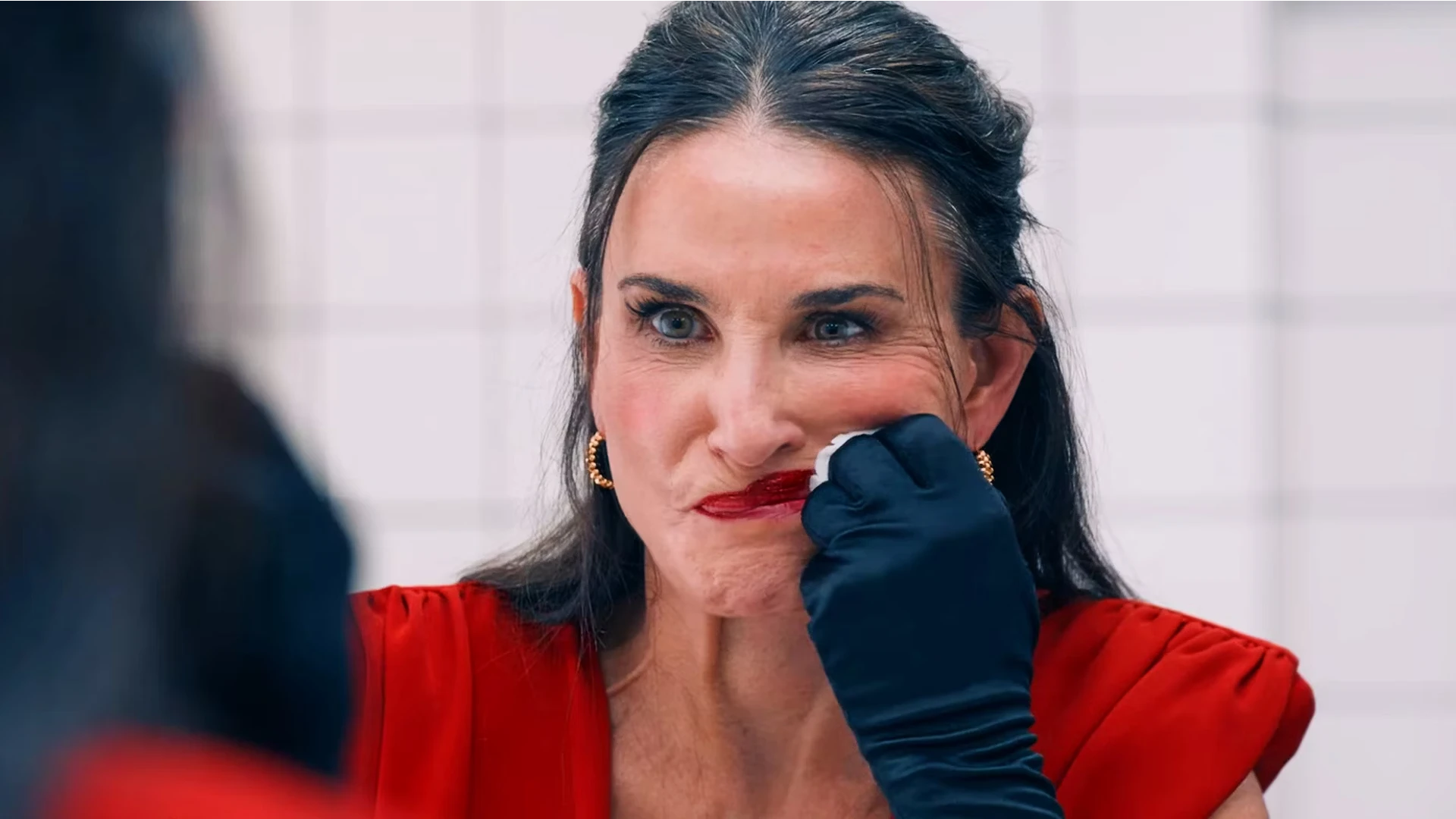
Moore does some of her best work on a much smaller scale. Getting ready for a date, Elisabeth keeps returning to the mirror to adjust her makeup. For a little while it’s an ordinary ritual, and there’s real pleasure in the prospect that she might go out and enjoy herself. Moore lets each adjustment register as a reasonable last thing to fix before she leaves. By the time her hands turn angry, it’s hard to say which trip to the mirror was the one too many. No elaborate makeup effect in the film quite matches the distress Moore can convey simply by rubbing makeup off.
Qualley has the trickier assignment in some respects. Sue is supposed to be instantly desirable on camera, and Fargeat shoots her fitness routine in glossy fragments that barely require the presence of a person at all. What Qualley adds is an aptitude for the job. She knows where to direct a smile and how to make strenuous movement look like an invitation to join in. It’s easy to understand why Sue would want more of this life, even as it becomes harder to like her for taking it. The script gives her fewer surprises than it gives Elisabeth, though. Once Sue discovers the benefits of being the favorite, her side of the weekly exchange settles into a fairly predictable rhythm.
That rhythm occasionally works against a film that runs nearly two and a half hours. There are only so many ways to photograph a body for a TV audience before the parody begins to feel a lot like another installment of the show. At other times, the repetition is just what makes the horror effective. Elisabeth’s cool, tiled bathroom becomes so familiar as the place where the women attend to the practical business of switching over that any new mess in it feels like a personal emergency. The flesh effects have weight and texture, and Fargeat understands the particular nastiness of asking someone to clean up after an injury in a room that ought to be spotless.
Anyone hoping for a discreet psychological drama should know that Fargeat has considerably messier plans than that. The final stretch goes on past good taste and then past the point where good taste seems like a useful thing to worry about. Some of its impact gets spent on sheer duration, but there’s a satisfying change in who the spectacle is for. The bodies on display no longer have to please Harvey, the TV audience or, for that matter, us. You don’t need nostalgia for Moore’s earlier stardom to appreciate the turn. A fondness for unruly horror will help, but what makes The Substance worth the time is the woman trying to get out the door for her date. After all the noise dies down, it still matters whether she makes it.