Michael Corleone has steady hands. That’s the trouble.
The Godfather still earns its reputation because Francis Ford Coppola makes the prospect of a decent son taking over a murderous business feel, for one dangerously persuasive moment, like good news.
Spoiler note: This discussion includes the ending.
The moment comes in a hospital. Michael Corleone (Al Pacino) has gone to visit his wounded father, Vito (Marlon Brando), and discovered that the men meant to guard him are gone. Out front, Michael stands beside Enzo, a baker who has come to pay his respects. Together they look sufficiently like bodyguards to discourage the men in a passing car. Afterward, Enzo’s hands shake too badly to work his lighter. Michael lights the cigarette for him, then takes a second to consider his own perfectly steady hands. His father is safe. A son has discovered something he’s good at. Under almost any other circumstances, you’d be proud of him.
Released in 1972, Coppola’s adaptation of Mario Puzo’s bestselling 1969 novel, with a screenplay by both men, found a fresh angle on the American gangster movie. The classic hoodlum’s ambition was to get to the top; the Corleones are already there, with all the headaches of an established firm trying to plan for succession. The story begins in 1945. Michael, home from the war in his Marine uniform, looks like the fulfillment of an immigrant father’s ambitions precisely because he has options beyond the family business. An attempt on Vito’s life changes what Michael believes he owes him. A Best Picture winner about that peculiar obligation marked a considerable expansion of what a Hollywood crime picture could encompass.
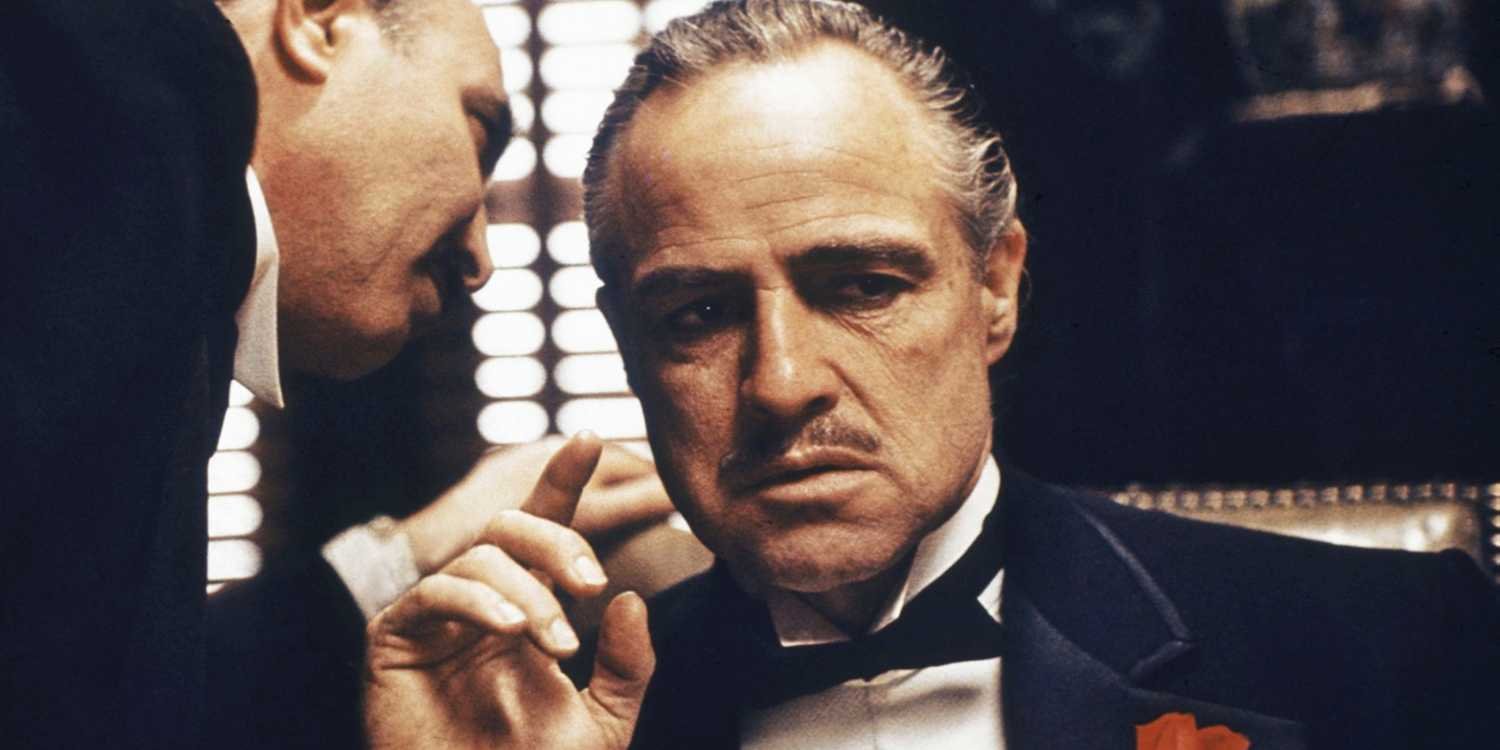
Coppola spends much of the opening at a wedding, making introductions under cover of a very good party. Outside, Vito won’t have the family photograph taken without Michael. Inside, he receives a petition from Bonasera, an undertaker who wants justice for his daughter. The camera starts close on the aggrieved man’s face and slowly withdraws until we can see whose audience he has secured. Bonasera has been doing the talking, but the shot belongs to the listener. Brando makes Vito’s hurt at being approached only when he’s needed sound rather genuine. That’s the catch with Vito: the affection is real, and you’ll owe him just the same.
Cinematographer Gordon Willis leaves Vito’s eyes in shadow for much of that encounter. The amber light is lovely enough to make the office inviting, yet it’s hard to imagine doing business on equal terms with someone whose expression you can’t quite see. Out in the daylight, James Caan’s Sonny scarcely has a feeling that doesn’t register in his shoulders. Robert Duvall takes the opposite tack as Tom Hagen, the family lawyer, who can listen to an insult with the professional interest of a man checking a contract for an unfortunate clause. Long before succession becomes urgent, the actors have given us a pretty good sense of who ought not to get the job.
Pacino has the trickiest assignment. How do you show someone acquiring the habit of giving nothing away? At dinner with the gangster Sollozzo and the corrupt police captain McCluskey, Michael looks almost stranded between the two older men. As he prepares to kill them, the sound of an elevated train swells until conversation hardly seems possible. There’s no need for a speech announcing his decision; the racket gives us a sense of the effort it takes to sit there another second. Later, when Michael speaks quietly across a desk, it’s possible to remember what that composure once cost him. It’s harder to tell whether it costs him anything now.
The film’s patience pays less handsomely during Michael’s exile in Sicily. His courtship of Apollonia has charm, especially the practical difficulties of a romantic walk with an entire chaperoning party bringing up the rear. But she remains scarcely more knowable after their marriage than she was when she first caught his eye. Her death matters chiefly for what it does to him. Back in America, Diane Keaton gives Kay, Michael’s eventual wife, a searching, skeptical intelligence that the screenplay calls on only intermittently. The men get to be funny at work, test one another’s judgment and make consequential mistakes. There’s no artistic necessity for the women to have quite so little time to themselves.
If anything, the film’s afterlife has complicated its achievement. Vito’s voice and his offer that can’t be refused passed so readily into comic shorthand that a newcomer might reasonably expect Brando to spend the picture issuing threats. The men on The Sopranos know the movie well enough to trade impressions; part of the joke is the distance between their behavior and the dignity they borrow from the Corleones. That dignity comes at a price. Coppola’s attention to the particulars of an Italian American wedding gives these people a life beyond crime, even as the film’s extraordinary popularity helped keep the association of Italian American life with the Mafia in circulation.
In the celebrated baptism sequence, Coppola cuts between Michael renouncing Satan on behalf of his godchild and the killings he has ordered. The irony isn’t subtle. The nastier pleasure is how satisfying it feels to watch so many outstanding pieces of business settled on schedule. Then comes Kay, asking a question about a murder and accepting her husband’s answer. From where she stands, she can see men gathering around Michael to acknowledge their new don, right up until one of them closes the door. For a first-time viewer, no fondness for mob movies or advance knowledge of the family tree is required. Just keep an eye on Michael’s hands, from the one that steadies a baker’s lighter to the one a subordinate kisses. Few movies have traced so clearly how a man’s finest quality can help make him terrible.
About Unspooling Great Movies: This INFLUX Magazine series revisits 100 celebrated films selected through a composite ranking drawing on IMDb’s Top 250, Rotten Tomatoes’ best-movies rankings and the American Film Institute’s 100 Years…100 Movies list. Bringing together audience appreciation, critical reception and historical significance, we explore what made these movies great, what has changed since their release, and whether they still deserve their reputations. Our individual movie ratings reflect a contemporary critical assessment rather than the films’ original consensus rankings.